Caffeine dreams in Salento

We were due to arrive in Salento around 4pm. At 3.55 the storm that had been threatening all afternoon, as we made our way through the Antioquia countryside from Medellin, broke.

Hauling our already-drenched backpacks onto our shoulders, we splashed across the flooded street into the tiny tourist office where we stood shivering until someone was able to call us a cab. I say “cab”. In Salento local taxis come in the form of 40-year-old Jeeps.

Nestled in the Quindío hills and the heart of Colombia’s coffee country, Salento is tiny, scruffy, but oddly charming. The whole place seems to move at an appealingly slow pace and the colonial architecture in the town square and its surrounding streets add a touch of vibrancy to this sleepy town.
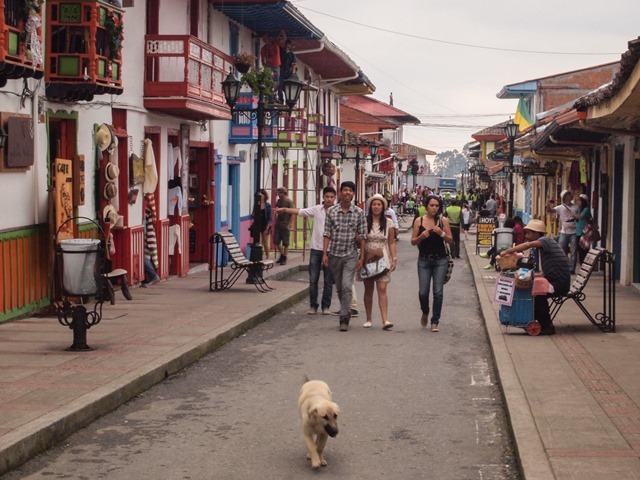
Salento Colombia

Outside the centre it’s fair to say the rest of the town is plainer and more functional. Fewer than 8000 people live here and they work in agriculture, tourism, and of course coffee production.

But the countryside that surround the town is breathtaking and that, after all, is why we’re here.

Salento Colombia

We arrived dripping wet at La Serrana, our farmhouse-style hostel, where they have hot showers (our first for a while). The cosy common area, filled with solid furniture and agricultural curios, was a welcome retreat from the thundering weather and we were only to happy to settle ourselves in for the evening.

People, ourselves included, come to Salento for two things: coffee and palm trees. We started with palm trees.

Nearby Valle de Corcora is home to the world’s tallest palm trees. A looped walking trail that takes you through the lush valley, up into the hills, reaching altitudes of 2400 metres, and back down again. It takes around five hours.

We took a jeep from the town square around 11am, arriving around 11.30. The last jeep back was due to leave the valley at 5pm. Which gave us exactly five and a half hours. Time to crack on.
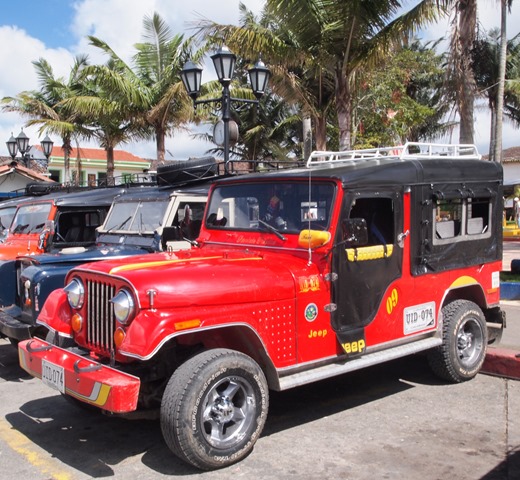
Vintage jeep

The route is not so much a walk as a scramble. It’s muddy, rocky, jungly, steep, wet and in parts you’re following the river so closely you’re practically in it. On our way up we passed a British family with two boys under five. At least two of the party were wearing sandals. I will never know how they managed it.

Valle de Corcora
Oh, and did I mention the dark clouds were starting to gather again?

Still, we weren’t going to be discouraged. We had heard there was a hummingbird sanctuary at the top where they also (and perhaps most crucially) served drinks and lunch.
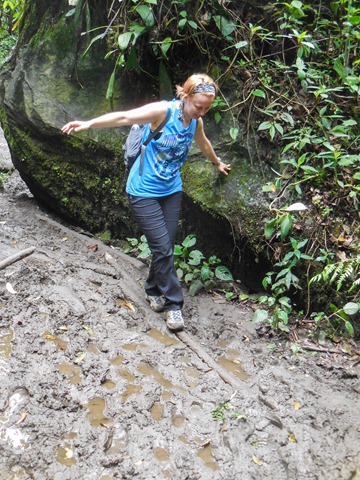
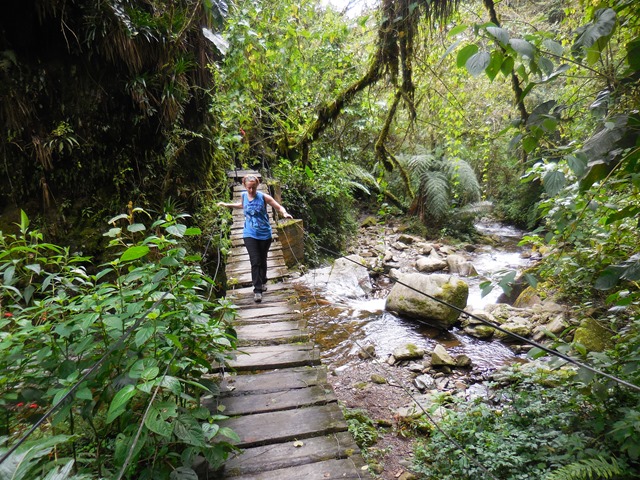
Valle de Corcora

Valle de Corcora

Like I said, it’s jungly.

We clambered over boulders, scrambled up muddy banks, lost our footing on several occasions and once, while balancing precariously on a tiny strip of path between a barbed wire fence and a muddy trench, slipped and accidentally grabbed a handful of spikes.

From the start of the trail to the hummingbird sanctuary took us just under two hours and after the uphill climb we were looking forward to sitting down for a hearty lunch.

Except it didn’t quite go like that. The “hummingbird sanctuary” is actually the home of a canny local woman who has put out bird feeders filled with agua panela  or sugar water to attract wildlife. And “lunch” is whatever she has in her larder to sell. By the time we arrived at almost 1.30pm, the cupboard was  virtually bare. Options included a single chorizo sausage, mugs of hot chocolate and some agua panela served with cheese (pretty much as revolting as it sounds). We said yes to everything.

As we sat down to pick at our meagre meal, we saw there were two hikers already there, finishing off what was clearly the last of hummingbird lady’s reserves.

“I’m done with mine, you’re welcome to finish it if you like,” said one, pushing a quarter of a plate of seasoned rice towards me. I am not in the slightest bit ashamed to say I took it. And I’m not embarrassed to admit the world looked a lot better after that leftover stranger-rice. Plus, there were hummingbirds.

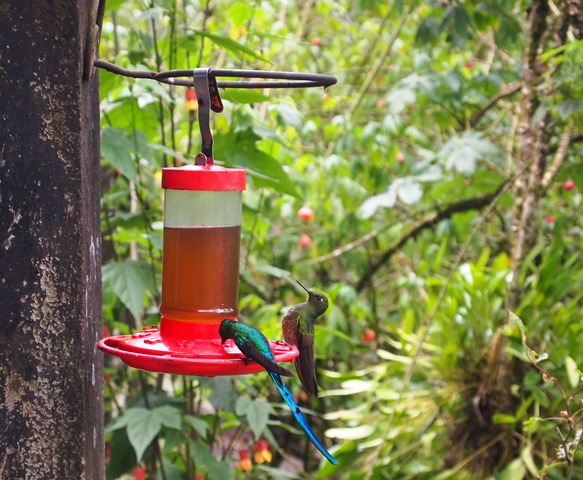
Hummingbird sanctuary Colombia

Hummingbird sanctuary Salento

On the way back  towards the trail we bumped into the British family with the kids, still climbing, the younger of the boys now riding on his dad’s back.

“Is it much further,” the dad asked. We assured him it was not.

“And can we get drinks there? Lunch?”

We hesitated, unsure whether we had the heart to tell them.

“There’s hot chocolate,” I volunteered.

“Wow, boys, hear that? Hot chocolate!”

And so with happy cries of “Hot chocolate! Hummingbirds!” they continued on their way. We, emboldened (and a little humbled) by the enthusiasm of these two tiny humans, scrambling through the Colombian jungle spurred on only by the vague promise of a hot chocolate, decided to hike on and climb to the top of the hill.

The Valle de Corcora trail begins at the road. You can start in the valley, as we did, and scramble up alongside the river, making a 1.5km detour to visit the hummingbirds, before climbing the final, steep, kilometre up to the finca (farmhouse) on top of the hill. From the finca, the walk down to the valley is an easy two-hour descent down a dirt road with breathtaking views along the way. Alternatively you can do it the other way around.

If you’re not much of a hiker, I’d very much suggest you do the latter because that final climb is killer. Also the breath-taking views are very much cloud-dependent.
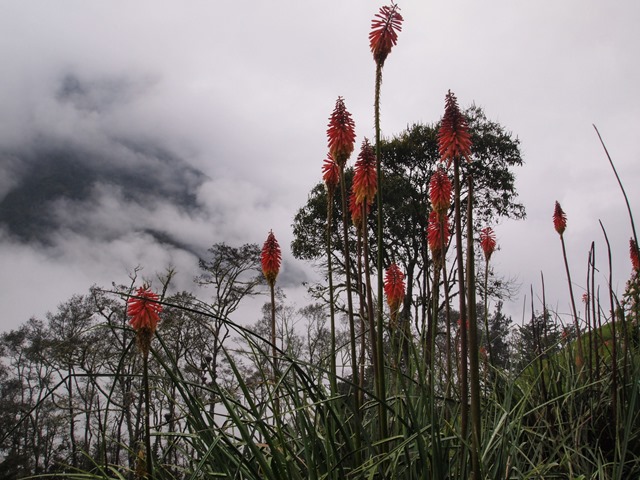
Valle de Corcora

Hmm. That said, there’s something wonderfully spooky about catching your first glimpse of the famous palm trees through the rolling fog.
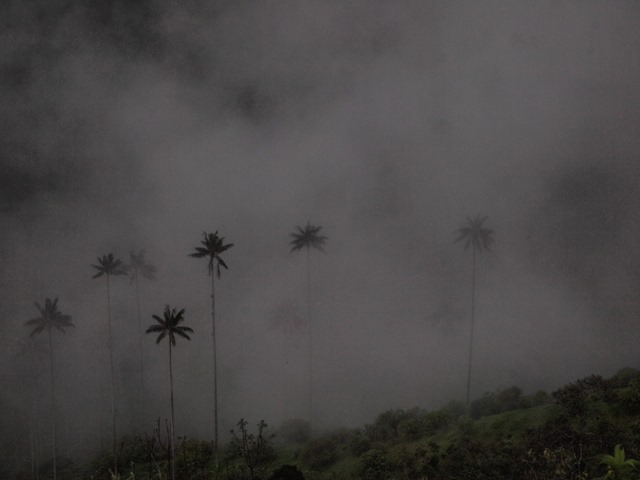
Valle de Corcora

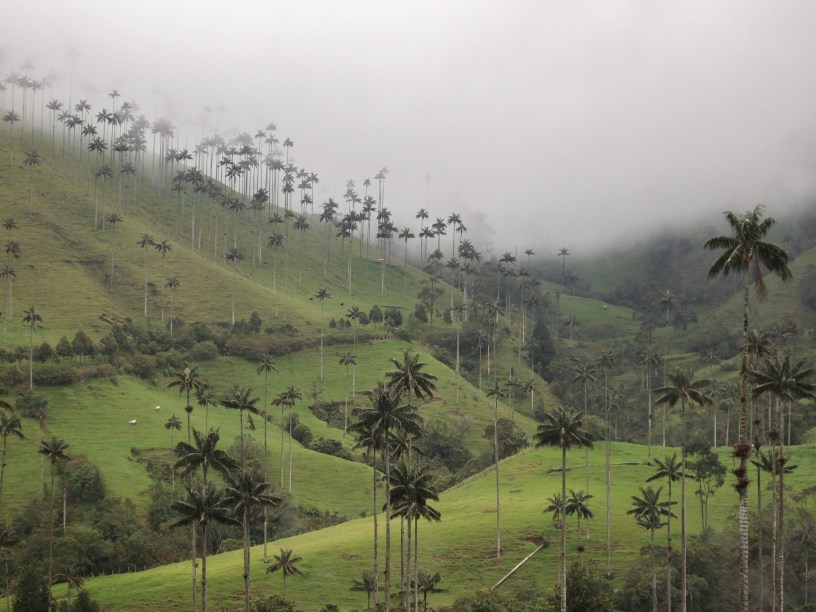
Valle de Corcora’s wax palms are the tallest palm trees in the world. Up to 60 metres high, they seem barely possible as they sway over the lush landscape. The effect is almost fantastical, like a set from a science fiction movie.

“At any moment,” said Rob, reading my mind, “we’re going to see a brontosaurus lurching towards us.”

As we descended out of the clouds, our surroundings became clearer and the verdant, mist-soaked hills rose up before us, studded with these amazing trees.
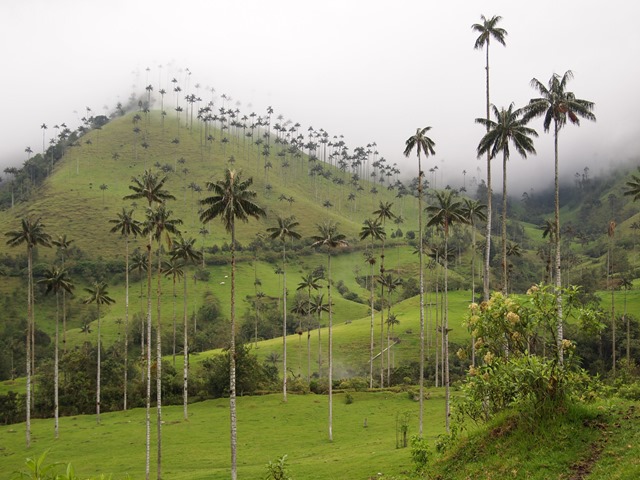
World's tallest palm trees

Towering above and around us on every side, they were every bit as breath-taking as we had been promised. Naturally, I took about a hundred photos but I’m going to be very self-restrained and only post one more…
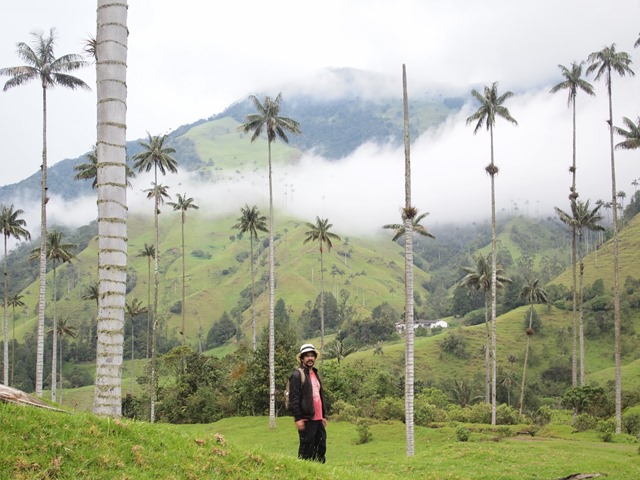
World's tallest palm trees

It was difficult to drag ourselves away. But the last Jeep back to Salento was due to depart and we had to go. We made it back to the road with fifteen minutes to spare.

The following day we went to visit a local plantation. Like many tourists, we had flocked to the area in the hope of sampling some of the purest, freshest Colombian produce, close to source.

Yes, as stoners to Amsterdam, so we came to Salento in search of coffee. Our hostel recommended the Finca Don Elias but be warned, the sign is hard to spot and the farm next door does a good line in nodding and smiling at confused visitors as they usher you in to their tour. Just so you know for sure that you’re in the right place, here’s the man himself, offering us bananas which he grows among the coffee plants to act as a pest-deterrent.
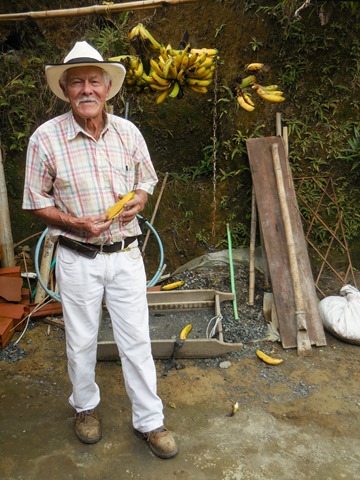
Don Elias coffee plantation

The plantation is entirely organic, as it has been since they started business when Don Elias was a young man. Banana, mango and pineapple trees provide shade while their fruits attract bugs away from the coffee and provide sweet compost for the soil.

Beans are picked by hand, and shelled using a hand-cranked machine. They are then laid out in a makeshift tarpaulin greenhouse to dry and roasted in great pans on top of the brick oven.
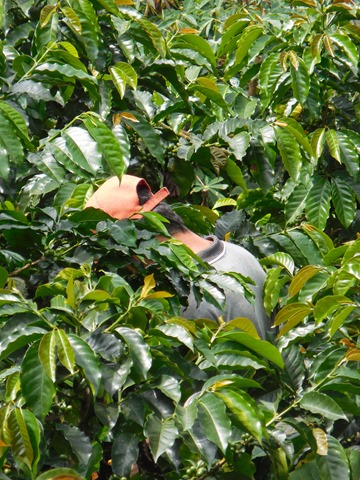
Don Elias coffee plantation

And if you want to buy a bag of coffee – which obviously we did – you also have to grind it by hand.
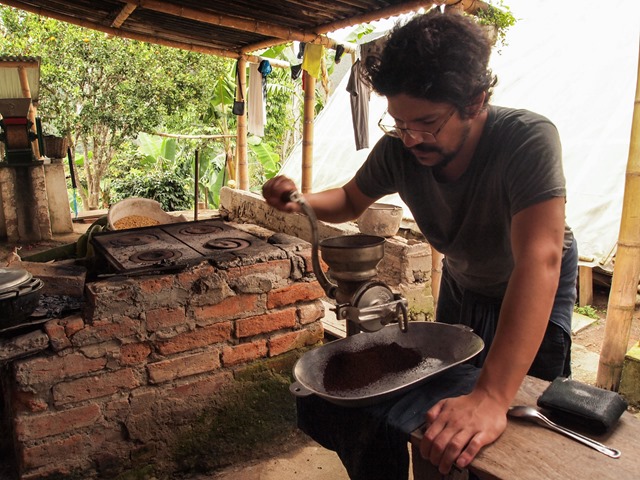
Don Elias coffee plantation

All that was left was to sit down and enjoy a cup of the stuff. There are pictures of me doing so but they’re not for public consumption. Let’s just say grinding coffee is sweaty work.

That evening we went out to sample Salento’s nightlife. You think I’m being ironic but let me ask you this, when was the last time you threw chunks of metal at a clay pit filled with gunpowder?

Tejo, the local pastime, involves arranging small packets of gunpowder into a “target” shape in the clay and throwing a 680g metal disc at this target. The gunpowder, as you would expect, explodes on impact and there are different amounts of points allocated depending on where on the target you hit. The pros (yes, really) throw from a distance 20 metres. We tried it from five.

I am and always have been terrible at all forms of sport so I don’t mind telling you I failed to trigger a single explosion. Rob, however, would like me to let you know that he got two direct hits. On the sidelines our new local friends barbecued meat and drank aguardiente  (a local aniseed liqueur) as though nothing in the world made more sense than to combine alcohol, fire, and explosive materials.

Finally, tired, tipsy and with the scent of gunpowder still in our nostrils, we made our way back to the hostel.

After three days in coffee country we packed up and were on our way back to the capital feeling as though we’d awoken from a strange and wonderful dream. Once again we’d experienced Colombia’s unique brand of magic… and, much like the coffee, it’s addictive.
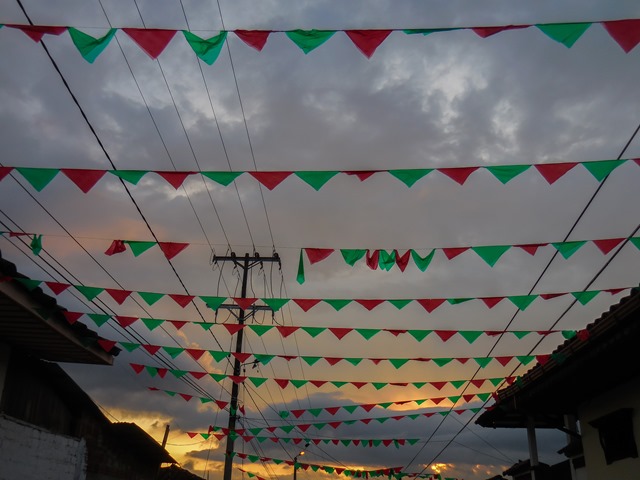
Salento Colombia

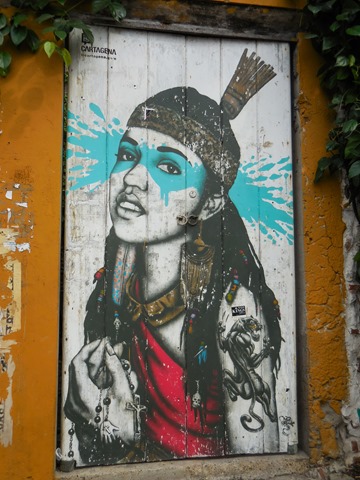
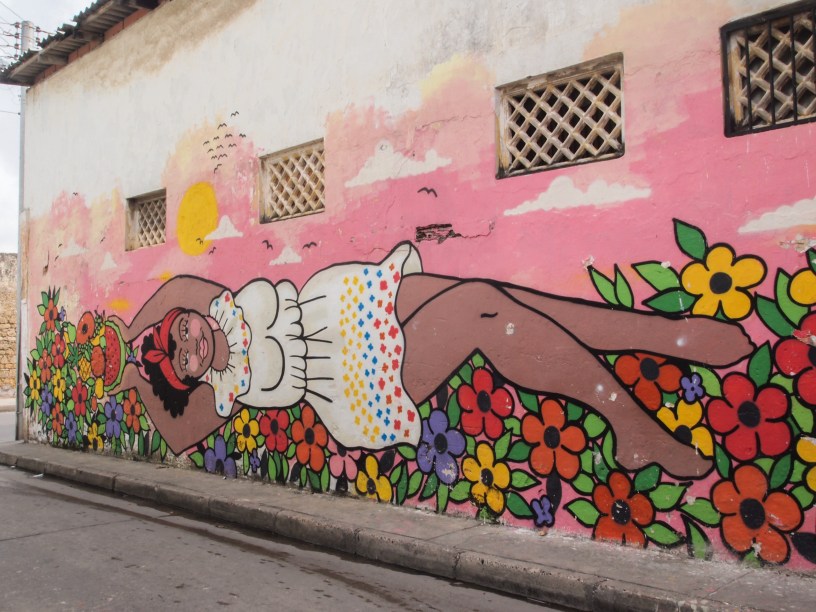
Cartagena street art

Love in a town of colour: Exploring romantic Cartagena

When my dad heard I was going to Colombia he did what most parents would do and gave me some parental advice. Not, as you might expect, about the dangers of travelling through the still-unstable rural areas. He did not tell me to steer clear of the perilous borderlands, nor lecture me on the dangers of illegal drugs, no.

What he said was: “Don’t take the bus to Cartagena.”

[No time to read? Skip to the end for my top 5 things to do in Cartagena.]

If you don’t get the reference, don’t worry, neither did I. Luckily my dad was only too happy to enlighten me.

For those unfamiliar with the 1984 classic Romancing The Stone, this is what happens to Kathleen Turner when she hops on a bus to the northern coastal city (the first 30 seconds pretty much covers it).

Yikes. In the end I flew to Cartagena. Not because I was worried about ending up in a ditch (in fact I am afraid of flying so on most occasions I would far rather take the bus), but because the bus from Bogota to Cartagena takes 20 hours while a flight takes an hour and fifteen minutes.

Cartagena was somewhere I’d been looking forward to. Mixing Spanish heritage with Caribbean climate, not only is it intensely attractive but it’s history and culture makes it unique within Colombia.

Cartagena street art

The city, perched on the edge of the Caribbean Sea was once among the most important ports in the whole of Latin America. Founded in 1553, Cartagena de Indias (to give it its full title) became a crucial stopping point on the way east from Peru and Ecuador onward to Cuba and Puerto Rico and back across the Atlantic to Spain.

The Spanish quickly found gold in Colombia, as they did elsewhere, and Cartagena itself was home to many indigenous burial sites, all filled with treasures that could be traded and sold. Unsurprisingly with so much gold passing through the port, the city was also a prime target for pirates – something that probably only adds to its story-book appeal.

But the uncomfortable truth is that a lot of Cartagena’s wealth came from the slave trade. In the 17th century the city became an official slave-trading centre – only the second in Latin America (the other was in Mexico). In fact many of the old city’s buildings were built on money made this way. Suddenly they don’t seem quite as charming, do they?

Beneath Cartagena’s dreamy surface lies a history at best uneasy and at times really quite dark. It’s a place of legend and mystery, romance and cruelty. It’s the town that inspired Gabriel Garcia Marquez’ fictional coastal setting in Love In A Time Of Cholera (in fact the city did suffer a major cholera outbreak in the 1800s) and after just a few days here, I think I can see why.

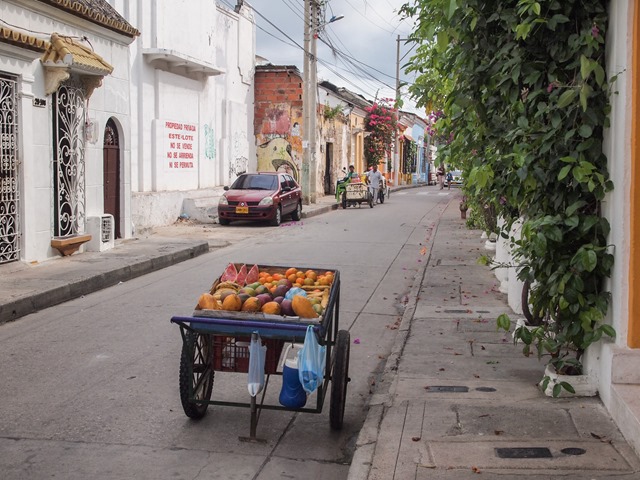
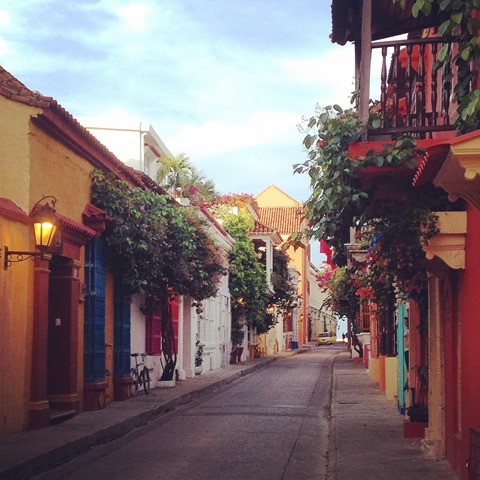
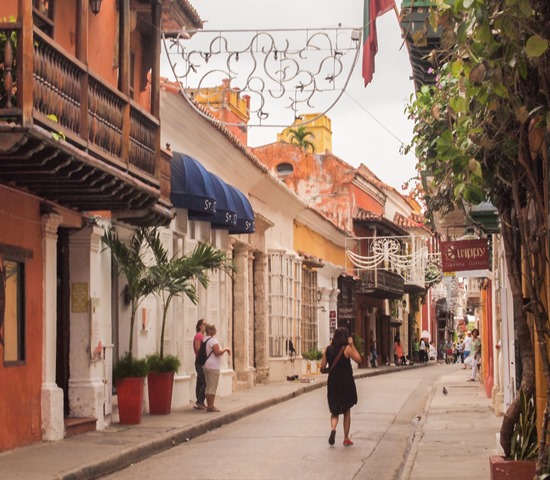
Cartagena street

The walled Old Town is now a UNESCO World Heritage Site. Outside this, it’s an ordinary working city and port with the majority of its 1million+ inhabitants working in maritime logistics, manufacture and exports (eg coal, petrol, sugar, and coffee), and of course tourism.

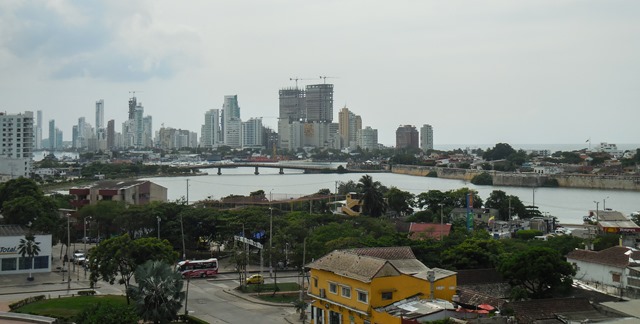
Cartagena skyline

Cartagena port

It’s as popular a holiday destination with Colombians as it is with foreigners and most people stay in one of the many chic hotels in the Old Town itself, in hostels in nearby Getsemaní, or in one of the purpose-built tower block hotels in affluent Bocagrande

I arrived alone on a Friday afternoon in December. Rob had left Bogota two days earlier to go to Valle Dupar for work and so I was going solo for the first time since we’d left the UK. I meandered idly round the vibrant streets and alleyways of Getsemaní – the ‘popular’ quarter just outside the walled city – taking pictures, enjoying being answerable only to myself.

Getsemani Cartagena

Getsemani Cartagena

Getsemani Cartagena

But as the evening drew in and I made my way towards to twinkling Christmas lights of the walled city, I began to miss my travel buddy. Not just for his Spanish-speaking skills (although they would have come in handy when I tried to explain to the hostel receptionist that to simply tell me “There six beds and only five lockers and yours is the one without the locker – sorry, is that ok?” was really not ok), but because Cartagena is seriously romantic.

Tiny, tucked-away restaurants, leafy plazas full of fairy lights, candlelit bars perched high on the old walls, overlooking the ocean, music, dancing – we’re talking picture-postcard levels of romance here.

Cartagena walled city

In fact I’d go as far as to say Cartagena is the second-prettiest city I’ve ever been to. I’ll give you to the end of this blog post to guess what the first is!

I consoled myself in Rob’s absence as any pining lover would: by going to the Spanish Inquisition Museum and looking at torture devices.

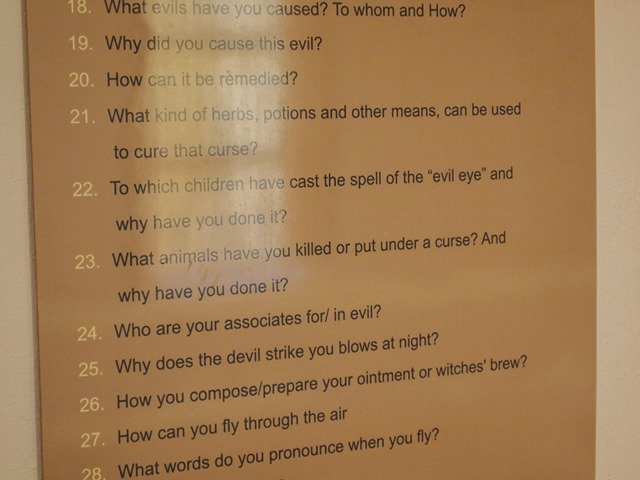
Cartagena was a key tribunal site for the Spanish Inquisition, with over 1000 people questioned and tortured here between 1610, when the tribunal was established, and 1700. The Palacio de la Inquisición, in Plaza de Bolíva is small and there isn’t an awful lot to see. But you can check out some of the more grisly means of interrogation and gauge whether you’d have passed the questioning. (Spoiler: You wouldn’t have.)

Spanish inquisition

Rob arrived on Saturday evening, tired, sweaty and, having eaten little more than an empanada and a bag of Colombian Wotsits in the last 24 hours, very much looking forward to a decent meal. We went to La Cevicheria, a seafood restaurant I’d scoped out, knowing that both of us love Peruvian ceviche and having heard that they did it pretty well in Cartagena. It was one of the best meals we had in Colombia.

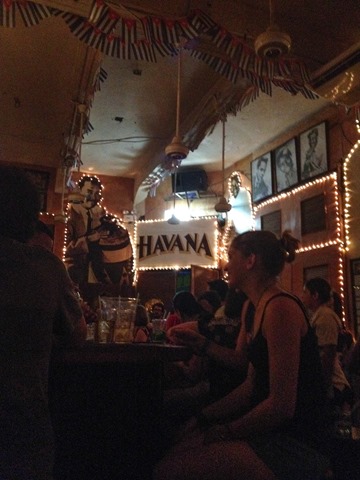
Reinvigorated by delicious fresh fish and a bottle of House White, we decided to check out Havana, a Cuban-themed club on the corner of Media Luna and Carrera 10 in Getsemaní. We took our place in the (mercifully short) queue, paid our 20,000 peso (£5.60) entry and went through the velvet curtain to emerge in a high-ceilinged hall dominated by an old-fashioned brass bar that starts at the back wall, runs almost the full length of the room before curving back round towards the far side once again. The place exuded an easy glamour, all twinkling lamps, clinking glasses and a nine-piece live salsa band. Photos of Cuban musicians and politicians decorated the walls and around the bar, tables were pushed back against the wall to allow people to dance… which we did, with varying degrees of aptitude and indeed coordination as the night wore on.

Havana club Cartagena

We nursed our hangovers, the following day, up at Castillo San Felipe de Barajas. The fort was built in in the mid 1500s and it one of the biggest and strongest ever built by the Spaniards. What remains today appears at first glance to be a rather ugly stack of stone. But it does have some pretty good tunnels, climbing between one level and another. For someone who still, at the age of 30, feels a flutter of childlike excitement at the thought of a secret passage, this seemed a decent trade-off.

The fort is also where the video for Colombian salsa singer Joe Arroyo’s hit La Rebelion was filmed, a song we discovered in Cartagena and which is now on our ‘travel playlist’ alongside some seriously dodgy Guatemalan hip hop and a lot of Latin power pop. Drawing on the history of the city it tells the story of a slave and his wife who decide to rebel and escape their masters.

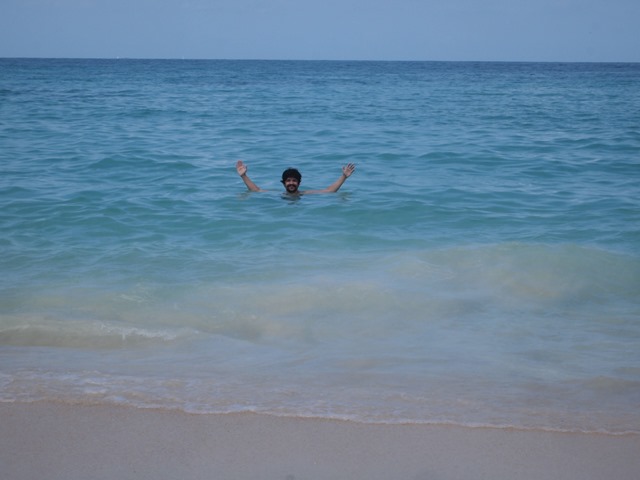
If you’re on holiday or travelling it is customary to try to be on a beach on Monday morning so as to be able to post a smug “Monday morning… doesn’t look so bad from here ;)” comment for the benefit of all your buddies back at home, who are easing themselves into a new working week. Of course, in Cartagena, the majority of your morning will be spent fending off tour agents, all of whom want to convince you their identical (and more or less identically priced) trip is the one to sign up to. Then, when you’ve finally agreed to part with some cash, flung your name on the nearest clipboard, and been issued with your tickets, you will spend another hour or two waiting on the dock while everyone around you seems to be getting on a boat until finally your name is called and you set off. The tedious rigmarole is such that I’d almost tell you not to bother. But if this is likely to be your only taste of the Caribbean, as it was for us, then you should go for it. And the beach, when you finally get there, is pretty heavenly.

Playa Blanca Cartagena

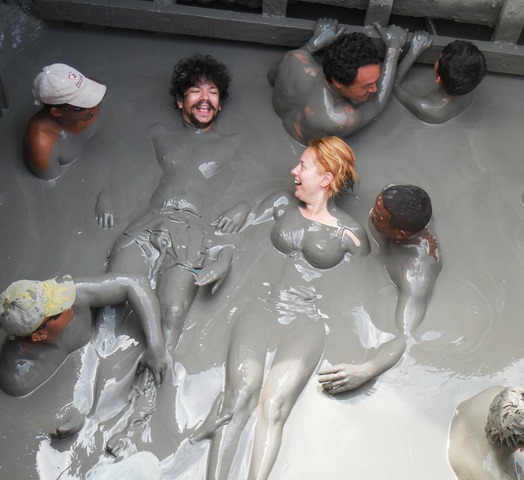
We rounded the Cartagena leg of our trip off with a visit to the Totumo Mud Volcano ($35,000/£10 each and we booked it through our hostel). The legend goes that it was once an active volcano which was exorcised by a priest who sprinkled holy water into its crater and turned its fire and ash to nourishing mud. According to locals, the mud is so rich in volcanic minerals that ten minutes inside will make you look ten years younger. I know, ridiculous.

We’d also heard tales of tourists, herded in to be summarily scrubbed and washed and filed out like a production line, with each person along the way demanding a handful of pesos for their services. At least one traveller told us categorically that it wasn’t worth doing. We did it anyway.

With it being the Christmas holidays, our tour bus was made up almost exclusively of vacationing Colombians whose infectious enthusiasm quickly dispelled any doubts we had about the trip. It was also where we met Ivan and his family, a Paisa who a few days later would show us round his home town of Medellin with equal enthusiasm.

Once up on the ‘volcano’ we shuffled round the edge before climbing down the ladder into the muddy crater. As the warm, grey sludge closed over our limbs, we found ourselves grabbed and ordered to relax and lie back for the massage. Tentatively we did. And while the massage itself is nothing particularly life-changing, the feeling of floating in a pit of mud 15 metres deep was very cool indeed.

Cartagena mud volcano

The mud gives you so much buoyancy that it’s actually difficult to stay upright as your legs keep trying to pop up to the surface. Eventually I managed to manoeuvre myself into a sort of standing position, suspended in the mud and from there could enjoy watching everybody else shriek with delight and bewilderment at the sensation.

Afterwards we made our way down to the lake to wash off with the (unsolicited) help of local women who scrubbed our skin, hair and even – having ordered us to take them off – rinsed and wrung out our swimsuits. Of course, all these people – the masseurs, the washerwomen, and the man who looks after your camera and takes snaps of you – do require paying ($3000/85p apiece). Given the utterly bonkers nature of the whole experience, not to mention how much I’d enjoyed myself, this didn’t seem too unreasonable.

On the bus on the way back, a young lad got on, explained he was saving up to go to music college, and then proceeded to belt out versions of local pop songs while accompanying himself on the guitar. Our new Colombian friends all joined in, looking at us questioningly when they saw we weren’t singing along. Okay, it’s not quite up there with Kathleen Turner’s bus trip experience… but it’s close.


Five cool things to do in Cartagena

1. Eat at La Cevicheria.

The classic Peruvian dish ceviche – raw fish and seafood marinated in citrus juices and chilli – can also be found in neighbouring Colombia, particularly on the coast of where the fish is fresh and plentiful. This place, on the corner or Carrera 7 and Calle 39 was fantastic. The blue and white colour theme, with fish and mermaid motifs just manages to squeeze in this side of kitsch and it serves an array of delicious seafood combinations, both hot and cold – all well worth the hour-long wait for a table. NB it’s closed on Tuesdays.

2. Lose yourself in winding cobbled streets.

Did I mention Cartagena was pretty? So pretty in fact that it’s quite easy to while away a day simply wandering around the old town, snapping pictures and stopping for the occasional coffee/beer/fresh coconut. I highly recommend losing at least a morning to its streets.

3.  Take a bath in a mud volcano

We’d heard that this was a bit of a tourist trap. No one is quite sure whether the stories about how the mud volcano came to be are true (the ones about it having been an active volcano, not the ones about the mud god) but the pull of doing something this unusual was too much for us. I can’t vouch for how beneficial it is but I can tell you it’s hilarious fun. We signed up through our hostel and it cost $35,000 (£10).

4. Salsa the night away in a Cuban-themed bar

It says something not very complimentary about our own culture that when we read that Havana, on the corner of Media Luna and Carrera 10, was the city’s best nightclub, we imagined a dingy, sticky-floored dive full of coked-up backpackers and churning out Latin electro-house. Instead what we found behind the curtain was a stylish cocktail bar full of  old-style charm and a live salsa band.

5. Dibble your toes in Caribbean waters

If this is your only  chance to hit the beach in Colombia (it was for us) then you’ll want to make the trip to Playa Blanca. While the city’s own polluted beaches are decidedly unenticing, the nearby Islas del Rosario and Isla Baru have everything you expect of their Caribbean location: white sands, clear turquoise waters, palm trees full of coconuts and beach shacks selling scrummy fried fish.

To get the most out of the beach you really need to stay there for a night or two but this can be prohibitively expensive (on Islas del Rosario) or unappealingly basic (on Playa Blanca). To do it in a day you’ll need to get up early and make your way to the port where ticket touts will compete to sell your their identical tours. Most cost around $60,000 (£17) and take you to visit various parts of Islas del Rosario, including a stop at the reportedly unimpressive aquarium, before dropping you at the beach for about two hours. If you want to skip the tour and go straight to the beach (as we did) you can easily negotiate this and you’ll pay a bit less, too. The return boats leave Playa Blanca no later than 3.30pm so it’s worth setting out early if you want to make a day of it. To work out which boat is likely to get going soonest, ask to see the tout’s clipboard before signing up. The boats leave when they’re full so the clipboard with the most names on it is the one you want to sign!

Cartagena Colombia

Oh by the way, the most attractive city I’ve ever been to is, of course, Venice. Did you guess correctly?

La Candelaria Bogota

How to be a hipster in Bogotá

The once dangerous capital is now the trendiest place to hang out in Colombia. Despite a history of violence and conflict, the city is now a hotspot of urban cool that regularly appears in Hip Cities of Latin America lists.

Everywhere in Colombia has seen dark days. The country’s second-largest city, Medellin, has emerged blingy and triumphant with a stereotypically Latin American appetite for tackiness. Meanwhile Bogota has taken the last decade of relative peace and order to nurture its vibrant cultural scene and international outlook. The result is a buzzing, arty city full of alternative places to eat, drink, shop, and party.

In short: Bogotá is hipster. And if you’re in town you’ll no doubt want to try to channel some that Colombian cool. Here’s how:

 Instagram some street art

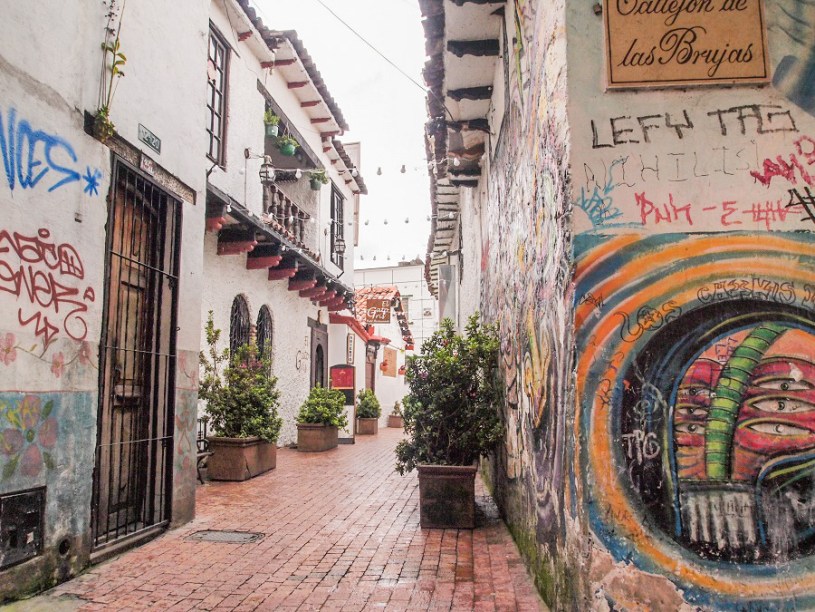
Like any hipster city worth its salt, Bogota has a thriving street art tradition. You can even do a graffiti tour which takes in some of the best work and provides some introduction to the most prolific artists . If you don’t want to fork out for the 20-30,000 pesos (around $8-12/£5-8) “donation” it’s easy enough simply to walk around and spot your own favourites.

http://instagram.com/p/wL_LTTx1pL/?modal=true


(NB Do exercise a little caution before waving your camera or iPhone around. Bogota is not the danger zone it once was but like any big city, there are opportunists who will gladly relieve you of your valuables if you give them a chance.)

Eat quinoa

I’m not sure it still counts as hipster to consume a food in the country of its origin but seeing as quinoa – along with its cousin amaranth – is only recently making a comeback in Colombian agriculture, I think we can include it. Unlike neighbouring Peru which produces and consumes the so-called superfood by the bucketload, quinoa was barely seen in Colombia for decades, doubtless due in part to the vast swathes of farmland and countryside taken over by guerillas.

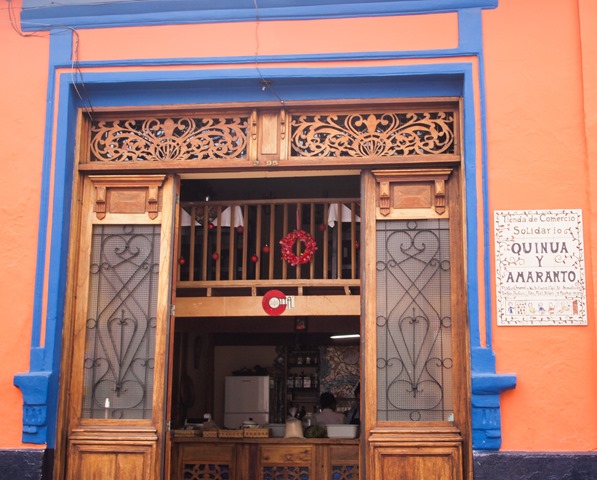
Quinua y amaranto bogota

Thanks to various farming initiatives, quinoa is back and gaining popularity in Colombia, as in the rest of the world, on account of its high nutritional value and versatility. In Bogotá you can try it at veggie cafe Quinua y Amaranto on Calle 11 #2. It’s open from 8am to 4pm and has a set menu, including a soup, a delicious plate of grains and greens and a pudding for around 14,000 pesos (£3.70/$5.80).

Drink coffee in a cafe housed in decommissioned transport

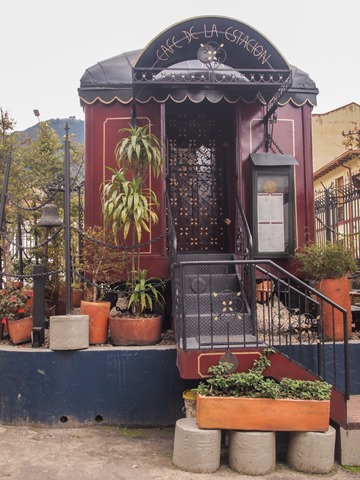
Taking a piece of public transport and turning it into a coffee shop is apparently THE thing to do in Bogotá. At Cafe de la Estacion on Calle 14 #5-14 you can go for coffee and cake in a charming old-fashioned train carriage.

Cafe de l'Estacion Bogota

And in the Parque El Chico there’s even a converted London Routemaster doubledecker bus. The 159 to Streatham Hill, to be precise – a bus I know well from home! What Tfl fuck-up caused to divert to Colombia? I don’t know. But I do know you can sit on its upper deck and drink coffee.

parque el chico london bus bogota

Wander around La Macarena

The bohemian, arty area of Bogota, this tiny hillside neighbourhood has boutiques, quirky cafes, restaurants and bars as well as some of the most developable property in the city. Forget loft conversions, how do you fancy refurbing one of these:

La Macarena Bogota

Chuck in a patched-up sofa and some salvaged door knobs and you’re away!

While you’re in the area, stop in at Tapas Macarena or its sister restaurant, tapas-Indian fusion cafe El Mat where the spicy satay dip with flatbread is delicious and the creations listed on the menu are as vibrant as the cafe’s interior.

El Mat Bogota

Have a drink in a cafe/bar/art space/gig venue/boutique

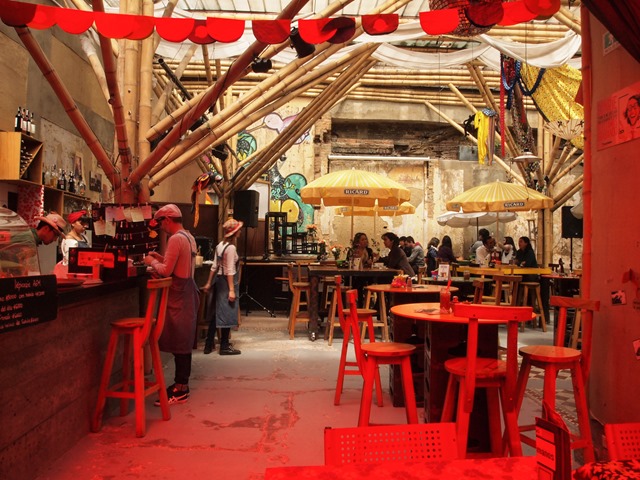
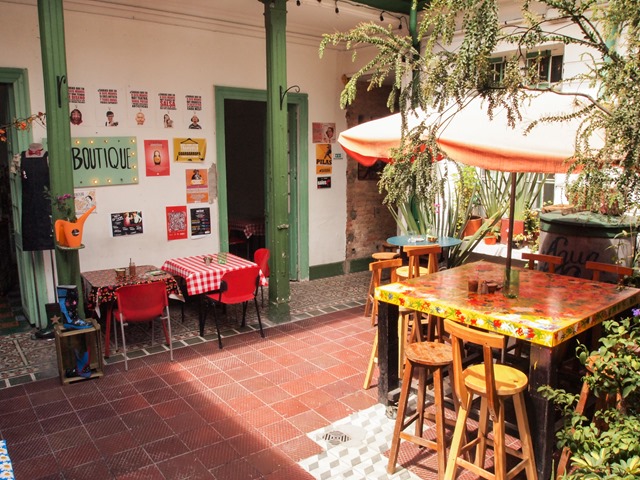
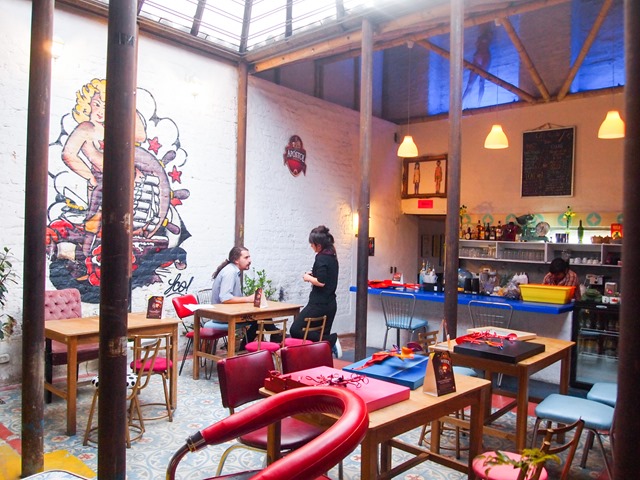
No hipster day out is complete without a stop at a multi-purpose venue. Step right up A Seis Manos. It has everything you need for the perfect experience: random objects hanging from the ceiling, tables decoupaged with vintage magazines, a chalk board of upcoming music and art events, an area inexplicably lit in red, and an annex with a vintage clothing boutique.

A seis manos bogota

They have a fairly full menu of food (think steak sandwiches), a variety of beers (see below) and their coffee is pretty decent too.

A seis manos bogota

Yes, I did give in to temptation in the vintage shop. Of course I did.

Hang out in Chapinero Alto

If you’re a trendy young thing living in Bogotá, mark my words this is where you’ll be renting an apartment. A residential neighbourhood with pockets of groovy bars, restaurants and clubs, Chapinero also offers plenty to amuse the trendy young visitor.

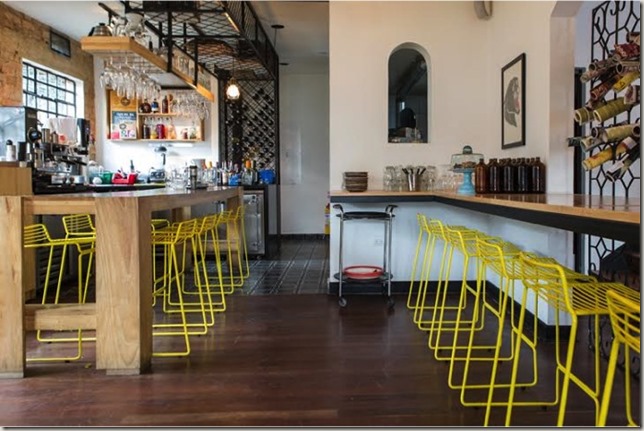
Salvo Patria Bogota

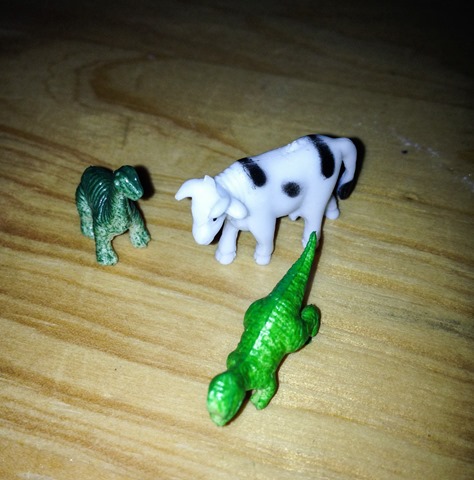
Bars and restaurants abound, with our favourite being Salvo Patria (have the lamb neck) which serves craft ales and brings you miniature plastic animals with your bill. What’s not to like?

Salvo Patria bogota

LGBTQ-friendly Chapinero is also home to Theatron, the biggest gay club in the city and many nearby hotels market themselves as “gay hotels”.

Day to day you can drink loose-leaf tea at the Taller de Té, watch independent films at In Vitro and realign your chakras at the bikram yoga studio.

Drink craft beer

Chelarte cerveza beer

According to Wikipedia, Colombia is opening microbreweries at a rate that outstrips regional demand. There is no source for this “fact” so I think we can safely assume it’s at least a mild exaggeration. It is, however, true to say that craft beer is on the up in Colombia, as it is in every part of the world that deems itself even remotely ‘with it’. The foremost player is the Bogota Beer Company, founded in 1997, which churns out a reasonable offering of ales, lagers and one porter all named after areas of the capital city. You’ll find them on draft and in bottles.

To be perfectly honest, they aren’t fantastic but they’re a welcome effort. In fact we preferred the  offerings from local cervecerías Chelarte and Moonshine. The American Pale Ale-style Raquel was just about crisp enough for me while Rob liked Moonshine’s Amber Ale.

And they all come with suitably artsy labels.

Get your hair cut by hairdressing assassins

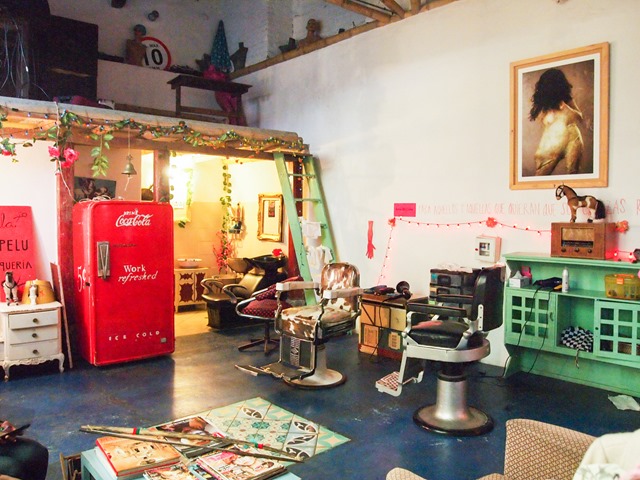
La Peluqueria hair salon, in Bogotá’s historical La Candelaria neighbourhood, describes itself as a “contemporary cultural art center” which offers not just a hair design service but an artistic experience and social event rolled into one.

La Peluqueria Bogota

The concept of the “hairdressing assassin” was created by founder Melissa Paerez who, after a period living in London’s uber-hipster Hackney, decided Bogotá needed a more radical approach to hairdressing. At La Peluqueria both male and female clients put themselves entirely into the hands of the stylist.

A brief chat on the kind of vibe you are going for is all that’s needed before they come at you with their scissors and razors. There are no mirrors and as you sit on your vintage salon stool in the middle of the mosaic floor, metal blades clicking around your ears, all you can do is pray that your requests didn’t accidentally get translated as “a number one all over”.

Never one to pass up on an opportunity to revamp my look, I let the lovely (English-speaking) Julia loose on my barnet. Here’s what she came up with:

Francesca Cookney

I gotta say I’m pretty chuffed and, if I’m honest, rather relieved! Cuts cost 40,000 pesos (£10/$16) and colour starts at 57,000 (£15 /$23) with top tend treatments such as highlights coming in at around 135,000 (£36/$56).

Oh and it’s a cafe and vintage shop as well – obvs.

La Peluqueria Bogota